When the Turtles Dance
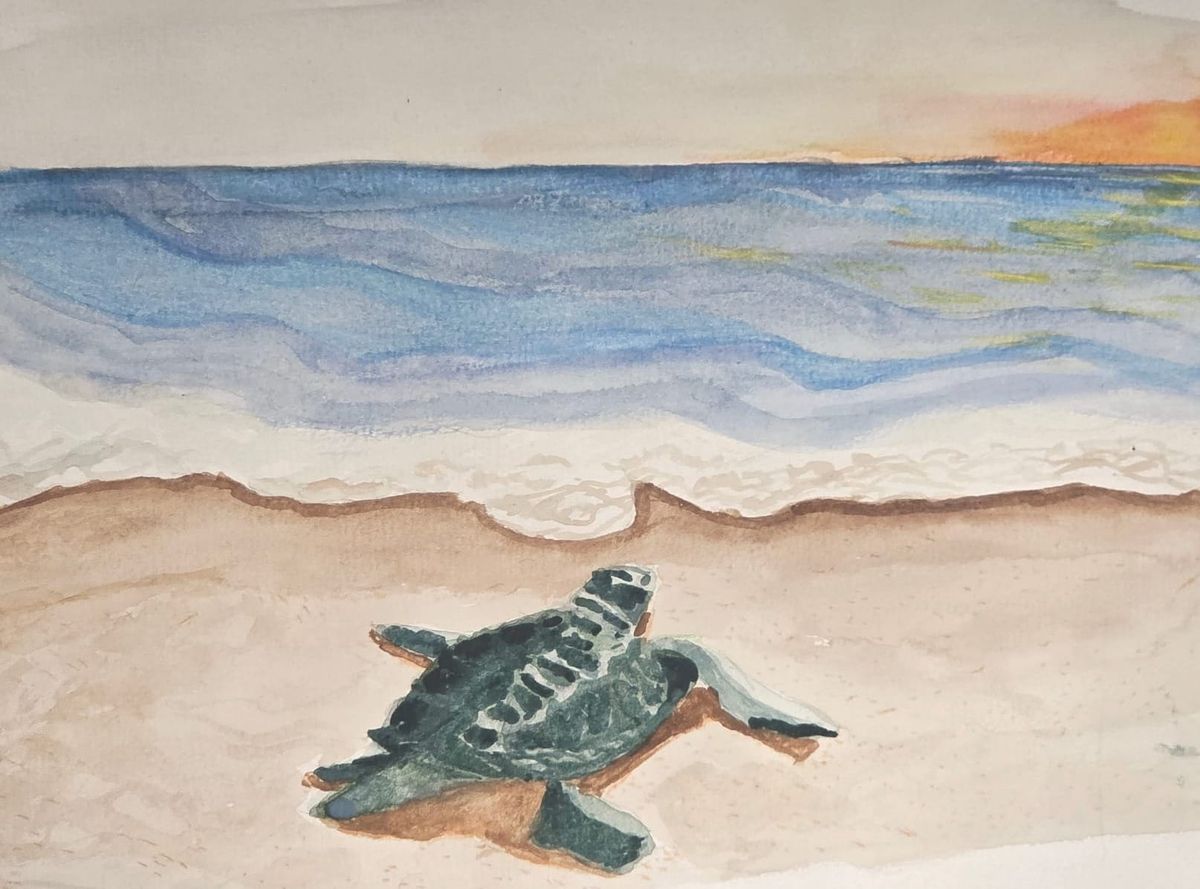
Chennai, Tamil Nadu - India February 2026
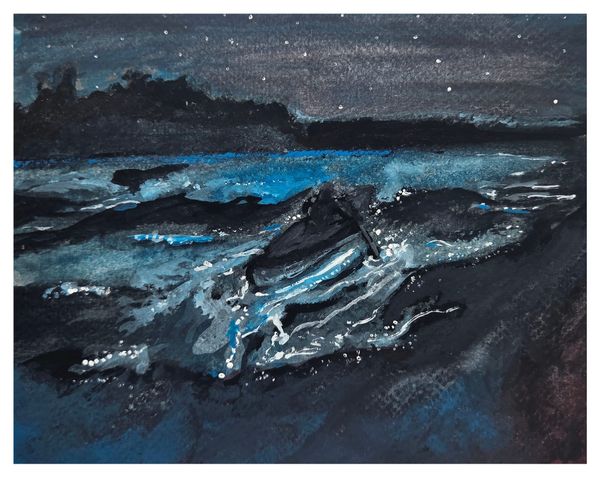
She lays her nest in the dark of a night sky
Lit by a city whose lights do not sleep.
The waves are her midwife
Egg sac full and ready to burst.
Her spot must be just right
for the legacy she will leave
buried beneath the sand.
Swish, swish!
she twitches her flippers and this way and that
a choreography that never had to be learned
knowing in the body as sure as the magnetite
that brings her back to her homeland after years
adrift
Wen she is done she does not look back
the little ones are covered fully into the ground
a ritual prayer for safety beneath a shifting surface.
Then she moves back down the slope
towards the frothing white foam
of a roaring black ocean and disappears
leaving only the prints of her padded descent on the shore
and a hundred soft possibilities lying in wait
of a salty ocean that will pull them out into a great big world
until they too return to their beginning shore
___
I
First, there is a black sea, with waves that have frothing mouths white and bubbling. The push-pull of its breath is like an incessant roar. Seventy of us trapse through the sand, dragging our feet, unbuckling sandals and chancing dead fish, crabs, glass bottles, trash and feces that may lie in wait in the dark, loose sand.
We are following organizers from the Student Sea Turtle Conservation Network public turtle walk. We are a bit like shadows today, observing a laborious and intensive daily process that spans kilometers of beach all meant to ensure the safe hatching of Olive Ridley turtles on a swatch of India’s southeastern coast.
Saving them is a delicate conversation, one that asks tricky question about how to protect our earth at scale when human behavior remains stubbornly unmoved to change, and when economic systems disadvantage even those who revere the environment.
Olive Ridley Turtles are a vulnerable species, though they are the most common sea turtles. They are known to form Aribadas, or mass nesting events, and return home to their natal homes to nest. An element called magnetite in their brains serves as an inbuilt compass helping them navigate. They often get tangled up in fishing nets and drown, unable to surface for air and their eggs face many risks.
Back in college as part of my Environmental Studies coursework, I took a biodiversity class in which I remember a heated and lively debate about the push and pull of conservation. About determining the rules of what to conserve and how, whether or not conservation methods are invasive, and the politics of the players, who gets turned into the good guy and the bad guy. The murky gray nature of conservation was plain as day during our pre-walk discussion.
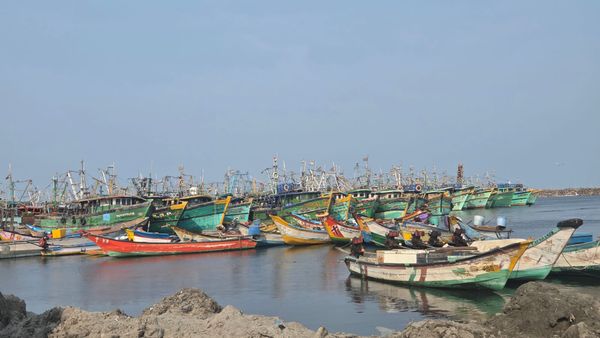
Our main volunteer guide, V. Arun who has been with the organization for decades tells us how hard it is to employ and measure a solution. For example, in the wake of several thousand turtle deaths, the Tamil Nadu government in 2017 set new rules for fishermen, including no large nets within 5 meters of the shoreline during nesting season. Trawling and mechanized fishing practices use nets that end up drowning the turtles. In an effort to find a solution, the government equipped fishermen with devices that could help exclude the turtles from nets. But there have been issues enforcing and tracking the usage of such a device, not to mention that fishermen get cast under the narrative of doing harm when they’ve lived alongside ocean ecology for generations.
A January 2025 article in India Today cites local fishermen explaining the many factors involved in environmental changes leading to both the turtle deaths and why they have to lay longer nets. Challenges include warming waters, less fish, not to mention the light pollution that deter turtles from nesting and lure them into the city instead of the sea after laying eggs. Though conservation narratives find a community – like fishermen – to blame, the fishermen along Tamil Nadu’s coast are the ones who have known the seas and its creatures for centuries.
In an article by Better India, Mervin Preethi writes that Tamil fishermen call Olive Ridley turtles by another, more affectionate name Kutty Amma Swami or little goddess. Fishermen do their best to avoid catching her in their nets and free her when they can. And many are actively involved in efforts to safeguard eggs along with SSTCN.
As Arun candidly shared, conservation should not require a human to go remove eggs from their natural nesting place. But in the absence of systemic shifts in curbing things like electricity usage, sometimes the more invasive option is better than doing nothing.
We shadowed the volunteers for several hours, a loud, imperfectly controlled gaggle of students and interested citizens, tracing the coastline against a dark sea. One of the young folks in the little group with whom I was walking volunteers with the group regularly. He said an unlucky walk would be one where we saw dead turtles. A lucky one would be if we found a nest. We were in for much more than that.
In several hours, we witnessed the full lifecycle of a vulnerable species. No less than a gift.
II
Death
We are greeted, first, by death. Carcasses in succession. Three of them. Large, shells of themselves. The SSTCN volunteers tell us many people mistake dead turtles for real ones, and yes in the dark I would not know the difference. It is likely they died out at sea and were washed up. A few years ago when over a 1,000 dead turtles washed up on shore, many were found to have died still carrying eggs that were never laid.
I steer clear, looking at each body as if it is still alive. With the protection of a shell it is hard to fathom the line between life and death. I wonder whether they breathed their last here, or if they had been washed up by the sea.
A group of boisterous boys behind me shine their flashlights on the ground, yelping and yelling, despite having been told explicitly by the volunteers not to use moving light sources as they deter turtles ready to nest from emerging from the ocean. I side-eye them, the way they look for crabs and the taunt the poor things, suddenly blinded by light, scuttling through the sand. The boys throw their chappals at the little creature, trying to clobber it. I wonder how they ended up at a conservation walk.
III
Conception
Only after walking about two kilometers did we find our first nest of the night. The volunteers had noted the uptracks and downtracks of the turtle’s flippers and found the location of a newly laid nest. We circled round as two experienced volunteers kneeled, sinking into the sand and cleared it away. Arun reached in, and began to remove eggs gently one by one. They are slightly smaller than golf balls, milky white and translucent, covered with grains of sand. They look gooey and we are told they are soft until they harden later. Sometimes new volunteers break them during this precarious moment.
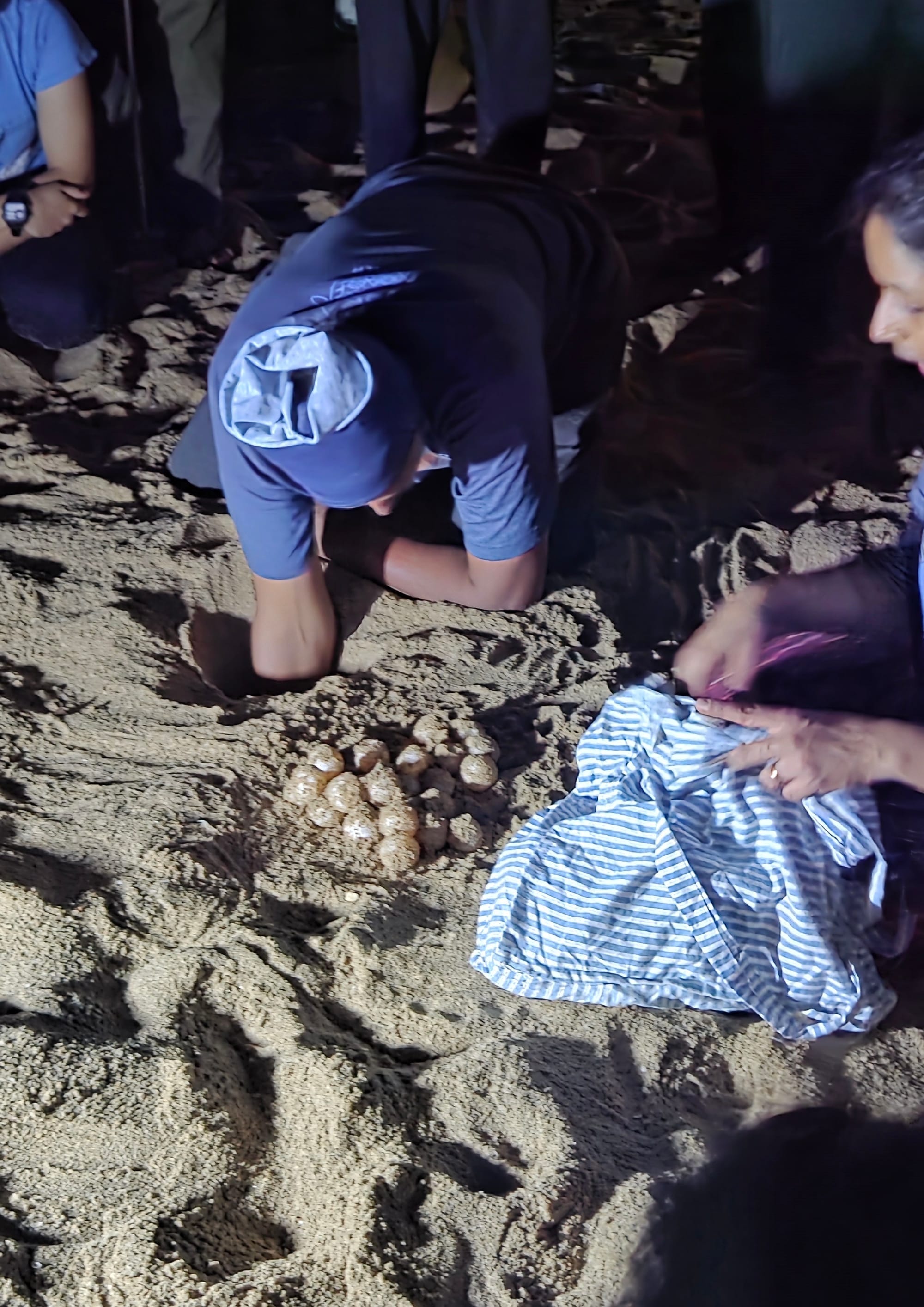
The eggs keep coming up. 10, 20, 30, 60, 80, soon we are at 100. The count ends at 140. They are all deposited into a cloth bag. Then Arun measure’s the nest – to retrieve the last egg, a grown man who is almost six feet tall needs to crouch down on his knees and stick his entire arm, up to his shoulder almost, into the ground.
We are in awe. I find this both surreal, and oddly normal. Like counting pebbles or a collection of rocks. Without seeing any turtle in sight and only the flipper-prints of the creature to herald its presence, I haven/t yet connected the whole process.
After a few more kilometers, I will.
IV
When the Turtles Dance
In the dark, the volunteers instruct us to be quiet. The boisterous boys don’t quite listen and egg on their friends too, whispering to each other “what are we doing here? What are we even looking at?”
We circle a safe distance around a turtle that is still on the shore. It is alive, and it appears to be in the process of nesting. It is settled into the sand, quiet, burrowing, a barely visible dark heap in the gray-brown night. My camera can hardly find its hazy outline, but my eyes- as bad as they are – can see it contours, can sense its aliveness.
Many of us sit on the sand. It feels like a prayer circle as much as a strange ritual of voyeurism. I am both enraptured and uncomfortable watching a creature during one of its most vulnerable, intimate moments of life.
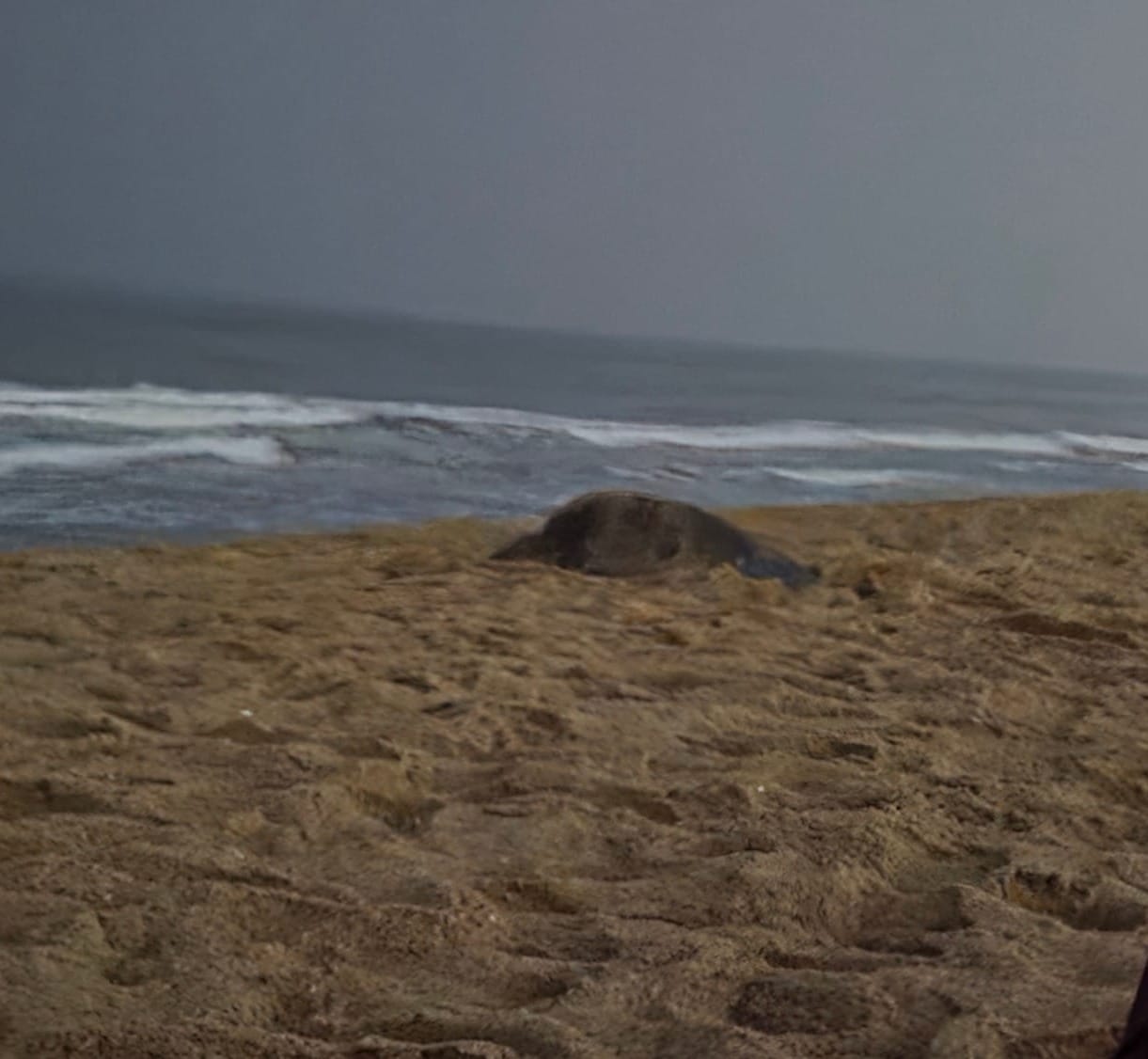
Then the turtle dances. Does what it has been born to do and has known to do without ever needing to know that it knows or question whether it will succeed. What must it be like to have that kind of intuition, that kind of primal instinct? This is the most magical moment, as it pats down the sand, its limbs orchestrated in movement to create a home for its future. A final act of care.
When she is done she quietly slips down the slope of sand and merges back into the dark night. She doesn’t look back.
We turn on our lights, dig up the eggs. This time there’s even more.
V
Fledgling
Our last leg of the walk is blessed by a hatchling. A little baby, barely the size of your palm. Of course, the hatchling was not found on the shore. One of the volunteers had gone to the hatchery and found the little one crawling around amidst a collection of eggs. He brought it back to release.
We crowded around again, with our questionable lights, and our voices, our gasps and our confusion. We watched the little thing zig zag in the sand, reaching with its inner knowing, magnetite for a compass pointing towards its destiny.
It went one way and then another, scuttling, then halting, like a dance of hesitation that looked much like a childhood game of redlight/greenlight. We held our breath, as if watching a thriller, cheering on the underdog with its tiny little shell and wobbly flippers as it made its way to the sea.
Once it found the flat wet, packed sand that flirted with the incoming seafoam, it stopped. Almost as if it knew this was the final frontier before it stepped into the depths of a great big, salty sea. It dipped its little flipper in once, but the sea couldn’t meet it quite yet.
Once more it scuttled at the in-between of sand and sea. Another wave and it disappeared. We all cheered, but as the wave drew back the little one appeared again. Finally, in the third attempt, it took its bold step forward and the sea met it in the middle, embracing it fully.
I believe at that moment, we may have all seen a little bit of ourselves in the hatchling’s brave walk to the precipice. I certainly did. Every day of adulthood feels like this, a scuttling zigzag of trust and uncertainty toward something bigger. Hoping to find my way, while knowing I will be swallowed whole.
VI
In perpetuity
The night gifted us vignettes of Ridley’s entire life, snippets of an age old cycle that continues along this shore for centuries and centuries. It is one thing to learn about life cycles in theory. Yet another thing to live a human life, cycling through all manner of things that distract from the very patterned, cyclical nature of what it means to be alive. And it’s a whole other thing - not all that novel or amazing at first, but quietly stirring – to be able to witness another creature’s life stages with one’s own eyes and presence.
This witnessing too, as special as it was gave me pause. Our light. Our voices, Our presence. In moments like these I wonder how I would feel if my most intimate moments were watched by a pack of other creatures peering with curiosity, judgment, confusion, or disinterest. Is that fair? Does it cross the line of tokenization, of again centering the human gaze which is at the core of a world that has turned nature and other creatures into commodities?
Maybe it does, maybe it doesn’t. I tire of answers. But the questions keep coming.
I dream of turtles when I sleep. How their brave little bodies know where to go even at the dawn of life. Faith of a different kind, that will pull them out to sea, send them out into the world, and one day bring new generations back home to their natal shores to dance a legacy into the the future.
Thank you to SSTCN for providing this public experience in Chennai.
This was Issue 3 of Micromoments. If you made it this far, I hope you had some tea with you and found some kernel of a thought, or reflection that came to mind.
This newsletter is one big experiment. I welcome your thoughts, suggestions, reflections and questions/concerns any time. Please feel free to reply to this newsletter. I'll be listening on the other side! - Kamna