Guilty Pleasure: the tension of tea
Tea. Three letters. One word. Many emotions: the warmth of home, hospitality, the opulence of High Tea. Nostalgia and rituals of home so easily get tangled with the history of colonialism and culture that sets the scene for this beloved drink.
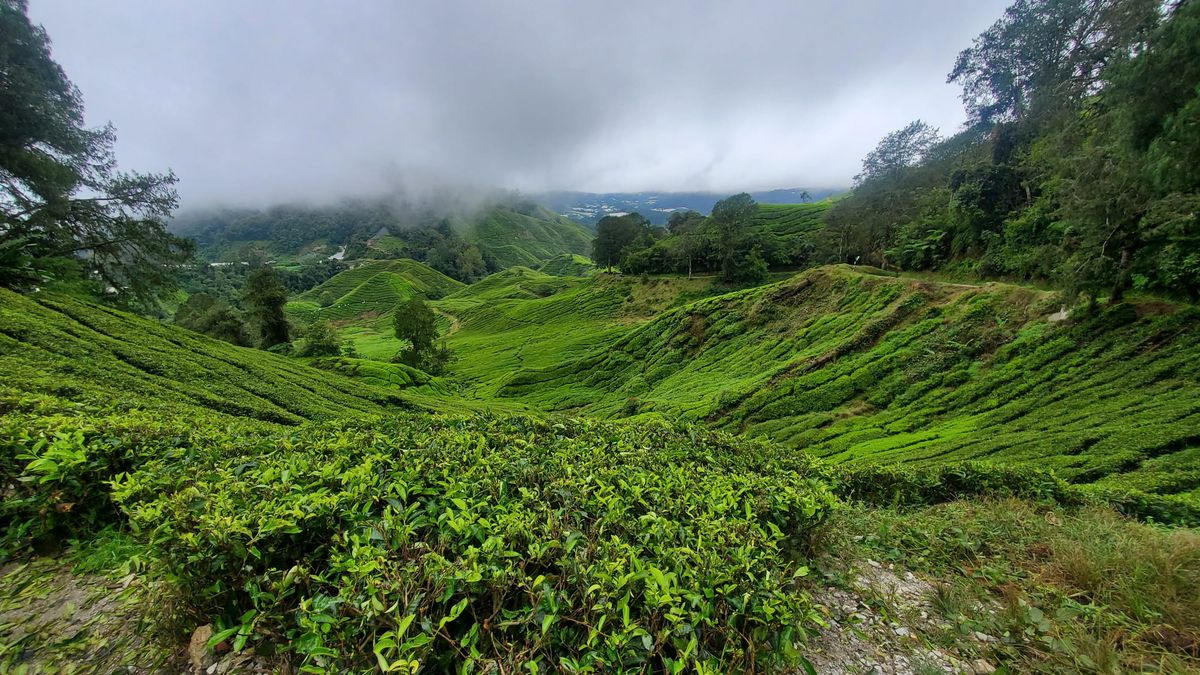
Cameron Highlands, Malaysia - November 2024
Tea. Teh. Chai. Cha.
Three letters. One word. Many emotions: the warmth of home, hospitality, the opulence of High Tea. Nostalgia and rituals of home so easily get tangled with the history of colonialism and culture that sets the scene for this beloved drink.
Standing at the ridge of a winding road that snakes through Malaysia’s lush Cameron Highlands municipality, I was in a face off with the complex reality of my favorite and most meaningful ritual drinks.
Tea is a deeply storied commodity especially when it’s taken out of my mundane life’s familiar context. On the daily, it is a drink I associate with India and it’s culture of hospitality. I grew up watching my mom simmering the delicious liquid on the stove every afternoon, and as a gesture of hospitality to anyone who visits. Ever since it has become a routine comfort which anchors the day.
Outside what I know it to be, tea is the struggle of history as much as it is a result of multiculturalism and human ingenuity.
I gleaned all of this in a matter of fifteen minutes as our tour group stood on the roadside. Our feet were covered in mud from our trek through the Mossy Forest where the muddied pathway was at the mercy of our guides and segments of rope that had been tied to trees. This same pathway may not exist in several months – the trail through the forest is always subject to weather conditions and as the morning proved, damp rain could easily change the path ahead.
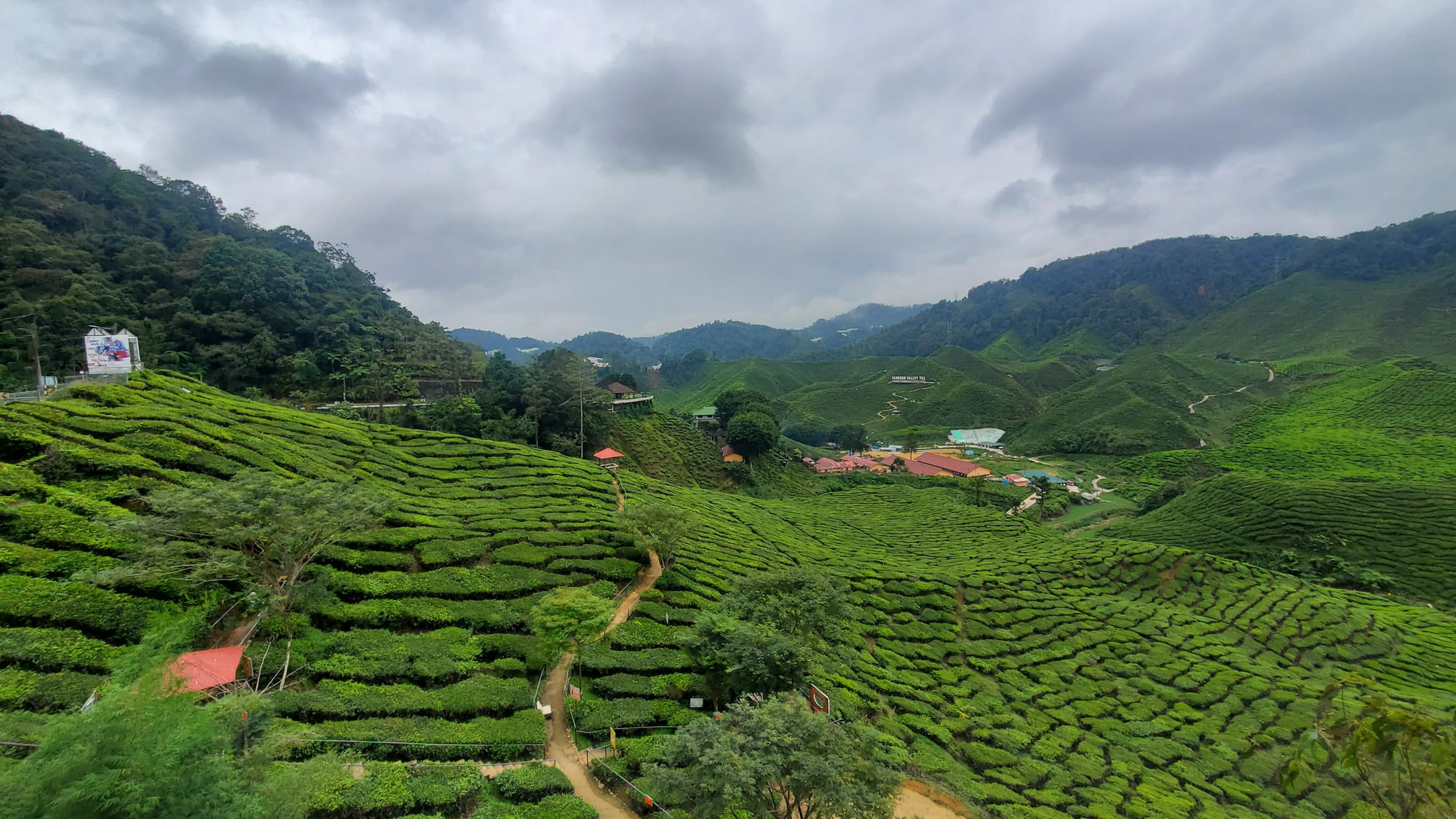
After hiking and slipping and trying to help one another over protruding roots and uneven ground, we were ready for refreshments and snacks. But before we stopped at the Best of Highlands plantation headquarters and café, our guides took us to a lookout point to admire the terraced emerald landscape where they gave us the spark notes version of entire centuries of history in just fifteen minutes.
The Best of Highlands tea plantation was - like most tea plantations - first owned by a Britisher during Malaysia’s colonial rule. The tea plant itself was brought from the hills of India and Ceylon where hill stations shared a similar climate to the Malaysian highlands. Laborers were brought to work the plantations by hand through indentured servitude, which contributed to the process of making Malaysia a multicultural colony.
According to our guides, this curving hill scape, in its pre-colonial state was full of trees and forests. The lush growth was razed to the ground and the tea plant was sown in rows with spaces narrow enough for workers to slip through and harvest the leaves.
Tea leaves are only tea leaves as we know them when the plants are young. If they grew into their full form, then the tea plant becomes a tree whose leaves are not harvestable and do not contain the caffeine content the plant is known for.
The Indian plantation workers planted, maintained, harvested and rolled the leaves by hand for processing. It was meticulous labor to get the best quality tea. The early 1900’s introduced a new machine that could mimic the hand-rolling process, reducing some of the detailed labor needed to process the leaves. There were so many Indian workers, especially from Tamil Nadu, that the tea company built a Tamil school for workers’ children.
After Independence movements took over South and Southeast Asia, worker demographics began to shift with the withdrawal of the British. The Indians who had previously migrated as laborers had integrated into the local culture and economy such that they had become locals – and they no longer wanted to perform menial labor.
The tea plantation continued to be owned by the British, even now it is managed by Caroline Russell, a descendent of the founder.
However, the employment model changed. Now rather than being employed fully, laborers come from abroad from placed like Indonesia, India, Bangladesh and Sri Lanka on three year contracts. They live in workers quarters and the company has built a temple, church, and mosque for workers. The Tamil school remains and busses children to and from their homes. After the three years of contractual labor are over, workers can choose to extend their contract, or return home. That is where the buck stops.
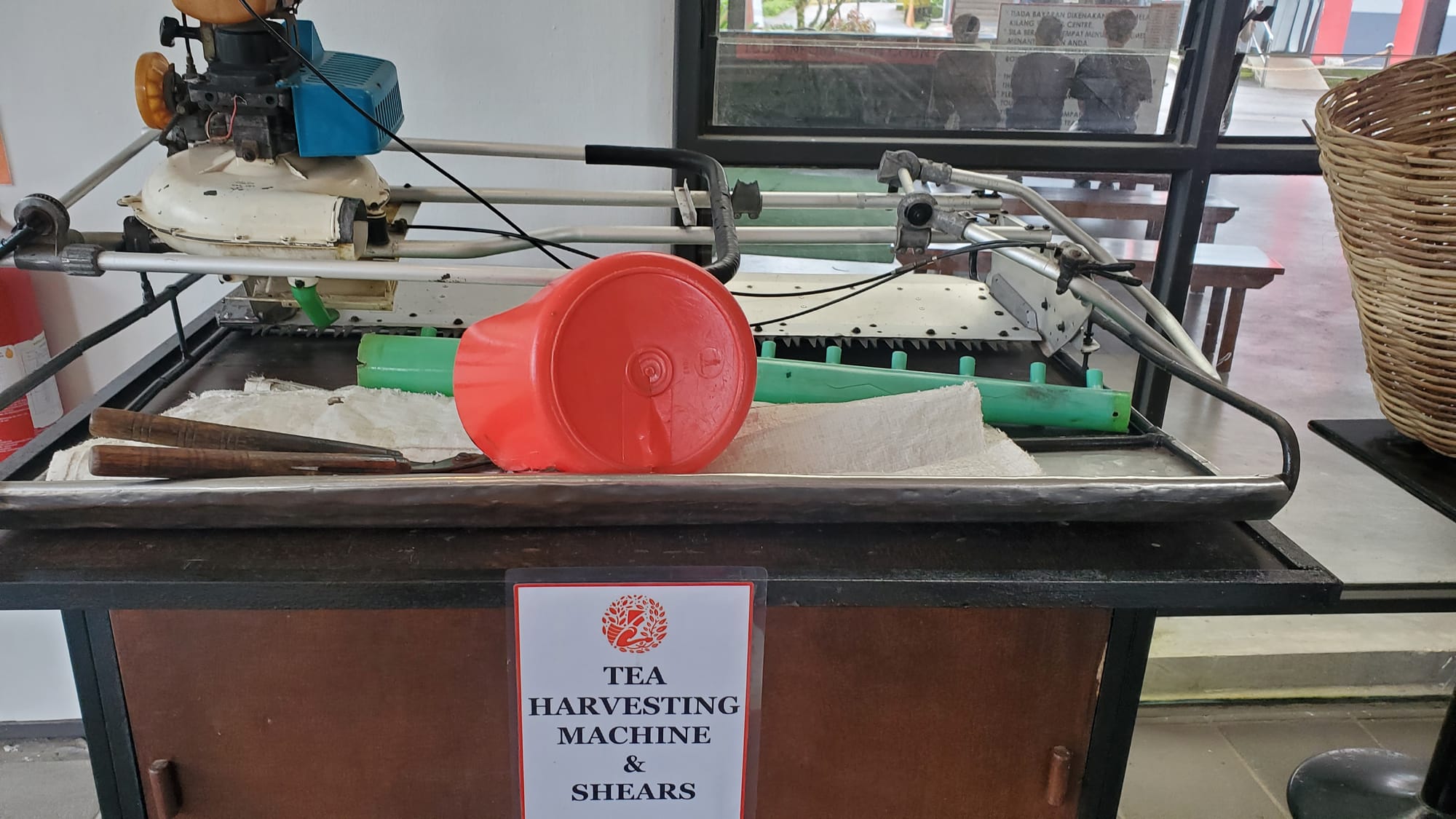
As contractors, the employees are required to work six days a week. Sundays are rest days, but our guide tells us that many choose to work on their off-days because they are paid per bushel harvested. They supply their own shears and equipment, which are on loan from the company.
Harvesting 1 kg or bushel of tea yields about 0.37 MYR. When you factor in daily expenses, sending money home to family, and the cost of renting the equipment they need for their work, this barely livable wage is spread thin. Its not an easy life to be a plantation worker, but again our guides – who are Malaysian Tamil – tell us that Malaysian Ringgit stretches far when sent home as foreign remittance and helps build stability for their families abroad.
Nothing about these labor dynamics is shocking or new. The fluctuations of supply, demand, labor and migration are familiar in countries around the world. You could go so far as to say capitalism wouldn’t function without this kind of unequal distribution of compensation.
The surplus production of resources is at the cost of cheap labor. This pattern takes place across the United States too, on construction sites and farms across the country. Its an age old pattern that is easy to ignore and unearths questions about the human cost of commodities if you stay long enough to look.
While looking out at the serene green landscape I grappled with the uncomfortable acceptance, it sat in my stomach like an upset. Something like tea that is the direct result of colonial forces and economic exploitation, is the very thing that encapsulates my connection to my own culture. The irony is my personal tea culture is something I hold as a quiet resistance to a world dominated by aspirations for Western ideals of success and acceptance. That cognitive dissonance is unsettling, guilt inducing too.
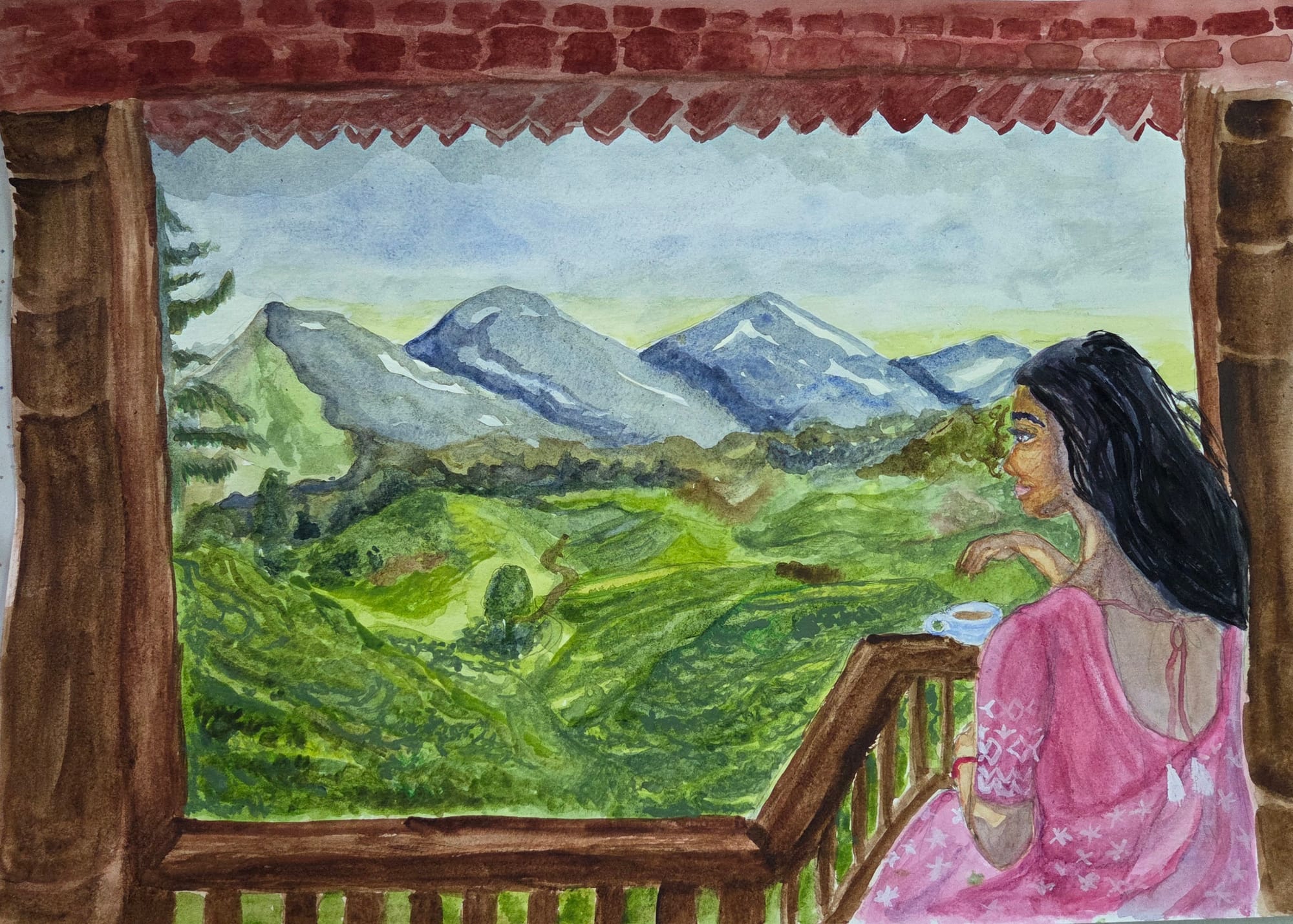
Many years ago I drew a black and white pencil sketch of a woman looking out at rolling hills of green, a clay teacup resting beside her elbow on the table. There wasn’t a reference photo for this hurried image – but when we arrived at the BOH tea plantation café, it was déjà vu. I had imagined this setting so many times, one of my imagined happy places that symbolized a feeling of calm, relaxed serenity that oftentimes felt beyond reach.
The menu posted up on a high-ceiling wall reflected a thali of cultural influences - scones and Teh Tarik, masala chai and sandwiches, kaya roti and cheesecakes. My fellow North American travelers (who would later become long-term friends) and I gathered at a wooden table up against a wall of windows looking onto emerald waves.
We were all struck; this was one of those perfect and our silence showed we all felt it. My Teh Tarik sat steaming in front of me, strong black tea, sweetened with condensed milk. The scones were warm and soft. I was satisfied just eating them with butter, no jam needed.
Banter and comfortable silence were equally easy with the little group I’d formed. The lush vegetation and comforting, flavorful drinks boiled down the simple things in life to a sacred trifecta – good company, good food, and a good setting.
All of it though, was only possible because of the complicated story our guides had just relayed to us. Our ability to travel across an ocean and spend 15 days going through Southeast Asia was only possible because of a globalized economy and system of trade built on cheap labor- direct results of colonialism. The people who benefited were usually sitting countries away, taking in the gross majority of the fruits of that manual labor.
I voiced this to my friends and we agreed something about it felt as though we were drinking tea made with slave labor. I took sips of my creamy The Tarik, focusing on my breathing as I wrestled with my thoughts.
Must we accept this hypocrisy and discomfort? In many ways multiculturalism, the mixing and meshing of traditions and influences in food and culture wouldn’t happen without the human propensity for trade, resources, and adventure. Unfortunately exploitation seems to be a natural byproduct of exploration.
How does one simultaneously enjoy this tea-drinking tradition and everything it symbolizes personally, while also stomaching disgust for the brutality of colonization and all manner of unfair labor practices? Was I a hypocrite to have such disdain for the system and still partake in the drink? Or did I sit on a high-horse to even ask the question, as if I could be the judge of fairness and equity in a world where nothing would be as it is if everything were predicated on ideals of equity and fairness?
I took a bite of the cheesecake the three of us were sharing. It was moist and cool, the textures well balanced. I’d had better pastries and cakes in Asia than I’d ever had in the US. That observation suggests something about how a certain region doesn’t really own anything. Cheesecake first came into its modern image in New York and yet I’ve had delectable versions of the confection in Malaysia with freshness and flavors that turn the cake into something uniquely Malaysian.
Tea too, may have come from India, but in Malaysia, if you harvest the tea plant and make Teh Tarik, you taste a distinctly floral back tea that is all its own. Take the same tea to the UK and English tea becomes another kind of specific ritual that is distinctly English – even if so many of the ingredients and spices came from their colonies.
My chai recipe wouldn’t exist had the British not colonized India and found the tea plant could be used for an energizing and flavorful drink. It would not exist without athe spices we roast and grind into masala that flavors that tea with a distinct Indian essence, personalized by each household.
I bought BOH’s highest grade loose leaf black tea, Palasi Supreme and later made masala chai with it on my paati’s gas stove in Chennai – but all those influences picked and brewed from various places and histories, still feels distinctly like my tea because of what it symbolizes. Reminiscent of family, of the familiarity of dipping Parle G biscuits in molten bronze, and the anticipation of gathering around the table with our tumblers and plates of mixture for thirty minutes of time together. It’s a constant that echoes across continents, places, and times.
And maybe sometimes that’s enough. When something holds so much value, its complex and fraught history doesn’t have to make it any less of a beautiful and meaningful thing. If I have to, I guess I’d call it my guilty pleasure.
This is Issue 8 of Micromoments. If you made it this far, I hope you had some tea with you and found some kernel of a thought, or reflection to consider.
*NEW*: If something did come up for you, a thread, a memory or experience, I have opened up the comment section for subscribed members. Please consider sharing your thoughts and ensure they are respectful, constructive, and invite intellectual/creative dialogue.
This newsletter is one big experiment. I welcome your thoughts, suggestions, reflections and questions/concerns any time. Please feel free to reply to this newsletter. I'll be listening on the other side! - Kamna