Vivi - y la sangre de la tierra (Vivi and the blood of the earth)
Oaxaca, Mexico - February 2025
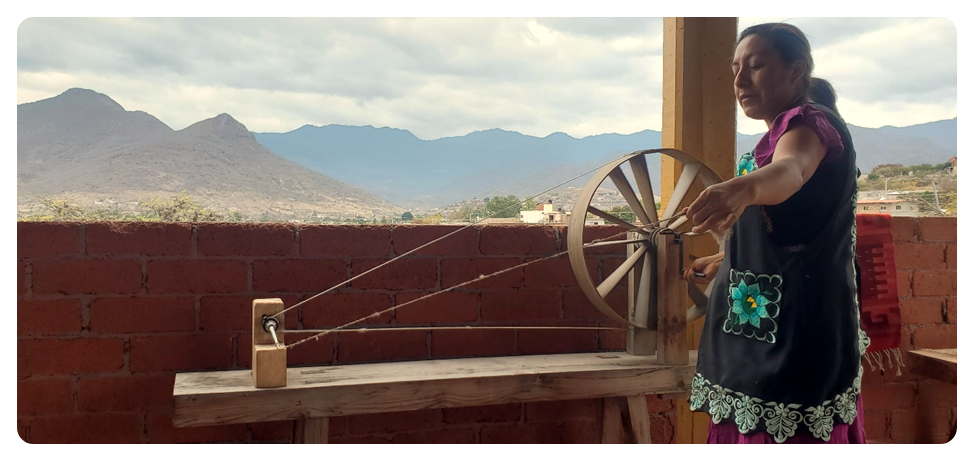
When Vivi invites a group to see her weaving workshop, she usually uses a translator.
But today, she does not.
She welcomes our group with strong, confident English . Her voice carries like the wind, breathy and bouyant but steady. Our guide tells us that Vivi has brushed up her English because she wants to be able to tell her story fully without an intermediary.
Her home and the artistic haven she has created in this edge town near the cultural hub of Oaxaca is special. A fourth generation Zapotec weaver, she is passing on the knowledge of wool, warp and weft to her six year old daughter who will be the fifth generation weaver of the family.
Vivi’s home is burgeoning with color, the same colors of the earth, of the red soil, and the undulating waves of blue mountains misted into the distance. The same colors of her dyed yarn are trheaded through bougainvillea blooms, and the soft greens of agave and nopal dotting the yellow hills.
The blue of the sky and the refreshing hue of water is channeled through indigo rock – Vivi has taken the world and spun it into a tapestry that holds the essence of the earth in one single breath. I am transfixed by the rainbow of yarn strewn about her workshop, each one hand dyed with naturally extracted pigments. Like the workshop of a divine color maker, she sees this ritual through from start to finish with her own hands.
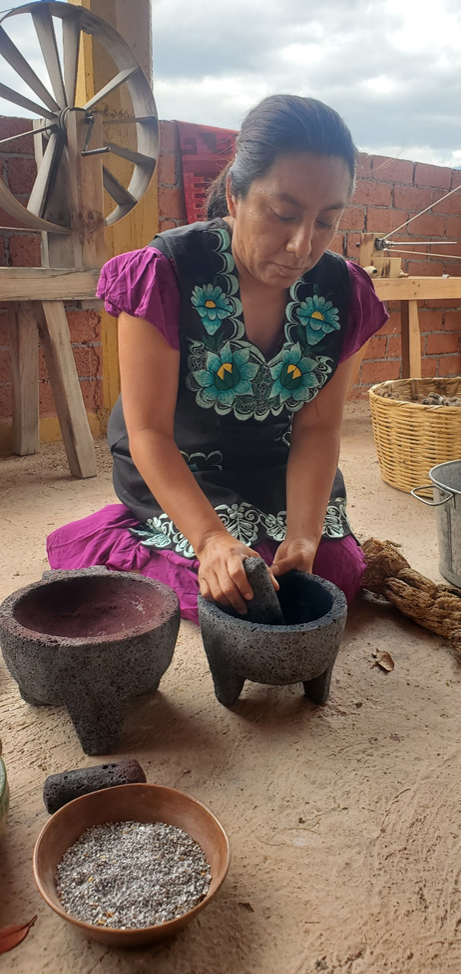
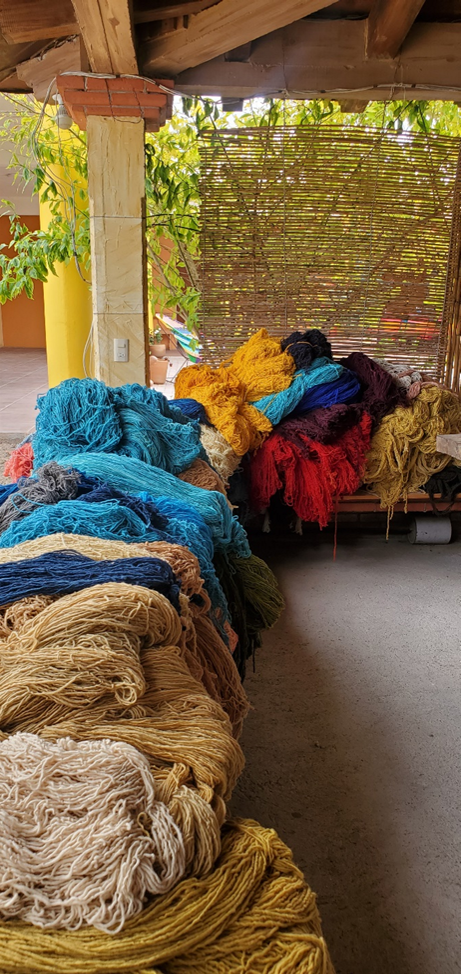
We gather under a wooden shelter with wooden stools, large buckets and a spindle where Vivi shows us how she prepares merino wool so that it can be soft enough for her to spin into yarn using a spindle. Then she grinds dense rocks of indigo into a dark blue that can create gradients of saturation, and crushes beetle shells to coax out a vibrant carnelian color. She explains that dried chamomile gives a soft calming yellow whereas marigold brings out a bright mustard hue and dried pomegranate turns yarn gold. She shows us how adding citrus to the pigment can create an even more complex secondary color including oranges, pinks, and purples. The entire rainbow and all the hues in between can be conjured with a just few foraged ingredients.
All of us are collectively transfixed as Vivi mixes the pulsed indigo powder into a vat of hot water, and then soaks hand pulled yarn into the mixture. When she removes the yarn from the dye, the blue dances into being, deepening with each moment of oxygen. It oxidizes from aqua to teal, and finally into a deep indigo.
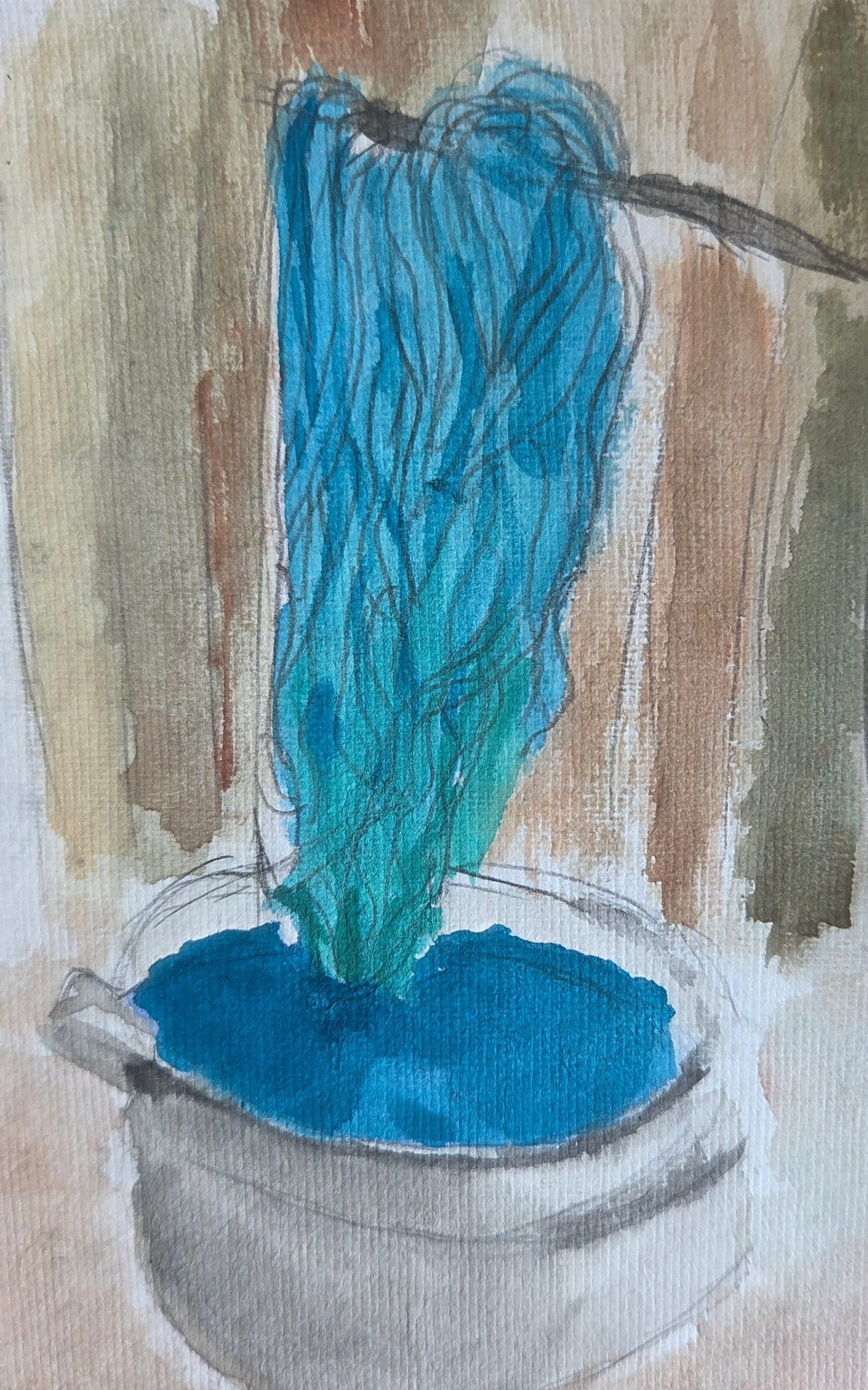
There is something about that kind of blue, an almost magical illusory color that is hard to find in nature except when the conditions are right on a sunny day when the air is just clear enough for that brilliant suggestion of a color.
Vivi has captured that beautifully saturated pigment, the one that makes me think of blue raspberry and childhood, wrapped into a skein of yarn before our very eye.
The ingredients in Vivi’s practice is a representation of the Oaxaca landscape. The mountains and the water, and the red of the earth… the phrase that keeps echoing in my mind is como la sangre de la tierra. Its an iron rich red, blood saturated, rusty, the color of terra cotta. It is the color of earthen homes the world over, and the undersoil peeking out at the edge of a meridian line.
That red has captured my heart – I’ve found it in every place I’ve ever fallen in love with. The rust red of Arizona and Nevada, the paddy fields of Tamil Nadu, and along the Manahan train route in Indonesia''s Java island. I've seen that earth in the lushness of Thailand, and now here In Mexico. .
The process of weaving is intertwined with earth and its elements. Pottery is made of immediate earth, of clay pulled straight from the ground. In contrast, weaving incorporates all the secondary and tertiary materials that come from earth. From sheep’s wool, pigments pulled from flower, rock, and the acid of fruit, to the breath and sweat that drips down a back bent across the loom, held together with wood – weaving may as well be an original creation story.
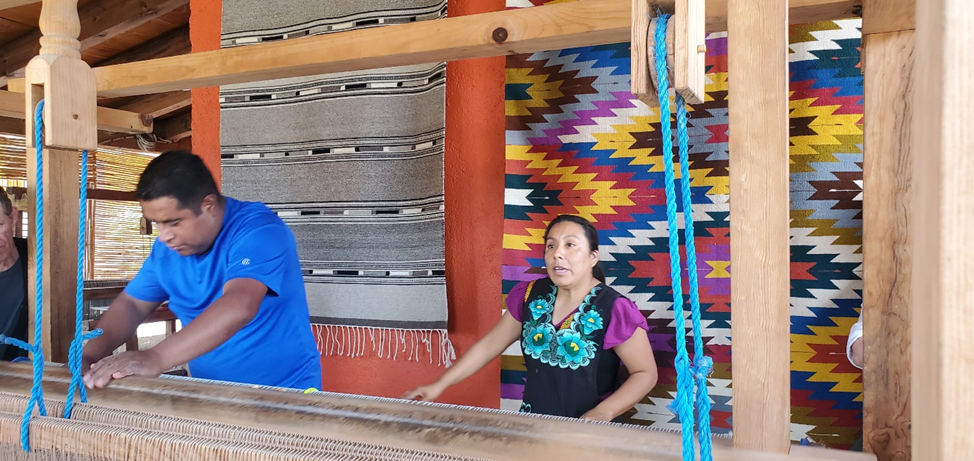
Vivi takes us into her studio, where finished rugs are stacked upon each other, some of the larger intricate designs on display on the walls. I walk around and brush my fingers across the rough, imperfect surfaces, with bumps and edges that are uneven – but beautiful in their imperfection. The irregularities are a testament to Vivi’s efforts, and those of her mother, and her husband. They are the cherished touch of the human hand, a reminder of the magic of imperfection especially in a time when we are marveling at artificial intelligence.
She pulls out several rugs and lays them on the floor to walk us through the different kinds of designs and their meanings. The intricate trees with their sprawling branches, beset with birds and animals, are a nod to the Mayan Ceiba tree. El arbol de la vida, the tree of life, unites all the realms of existence as essential to life. Then there is the infinity design, more abstract and symbolic, signifying the never-ending expansiveness of existence.
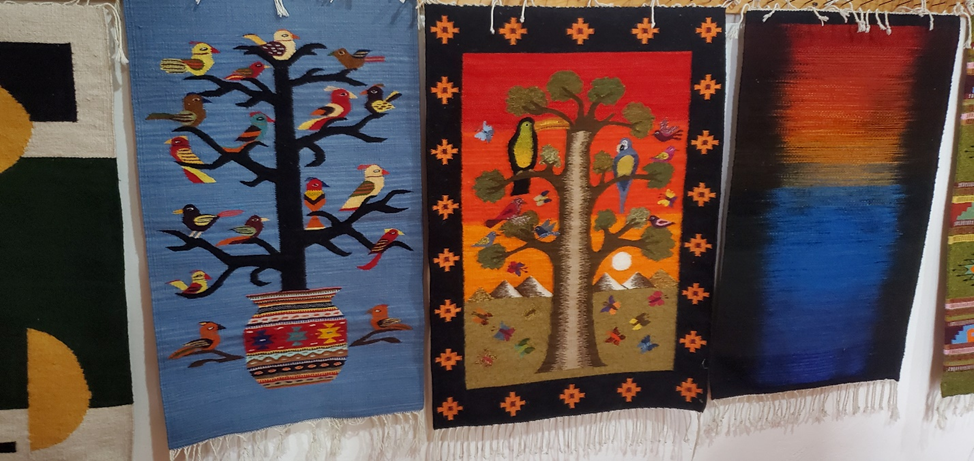
Kneeling on the floor, Vivi shows us a colorful piece with a diamond pattern that is meant to mimic the design of the universe and it’s corners These are more than rugs, they are tapestries, stories strung into fiber and whole cosmologies captured in yarn. No matter how often I see these practices in art – which are present across cultures – I am always enchanted. The way human expression is such a natural, universal pattern, more often than not inspired by similar motifs of nature, of life philosophies especially in folk and Indigenous traditions. Yet these shared patterns can manifest in culturally unique and specific ways.
The colors and patterns, their brightness and geometric form remind me of Navajo weavings, and of the kind of folkloric art style of Madhubani and Warli paintings from regions of India. While there are parallel trends of creativity across the world, every tradition has its own organizations of symbols, methods, and of course the stories and cosmologies that give the symbols and motifs meaning.
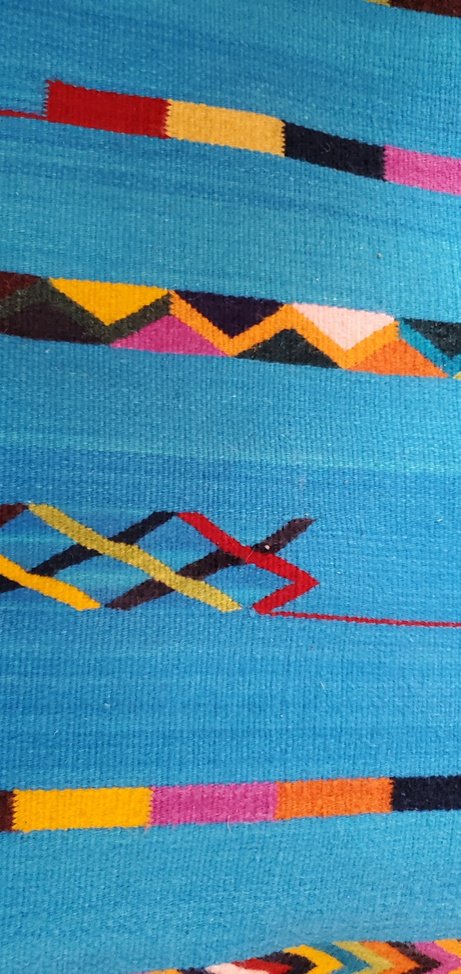
You can capture a whole person, a whole history, and a whole spirituality in a woven tapestry like this. No words or explanations needed. The essence is in the materials, the methods, the creative choices in the design, and in the lives of the very people – like Vivi, and her family – who weave them into something whole.
No wonder we like to use adages like “fabric of humanity” or “social tapestry”. A woven tapestry is never a singular final product. Instead, every element that goes into it’s creation allows a deeper meaning to emerge. It is the process of creating and becoming life itself.
Surveying the studio, I was overwhelmed. I knew I wanted a something with a trace of that delicious color of indigo. Summer skies, the beach, Mediterranean tiles. I wanted to drink up that color like water.
But somehow what spoke to me instead was a weaving hidden deep within a stack of small tapestries.
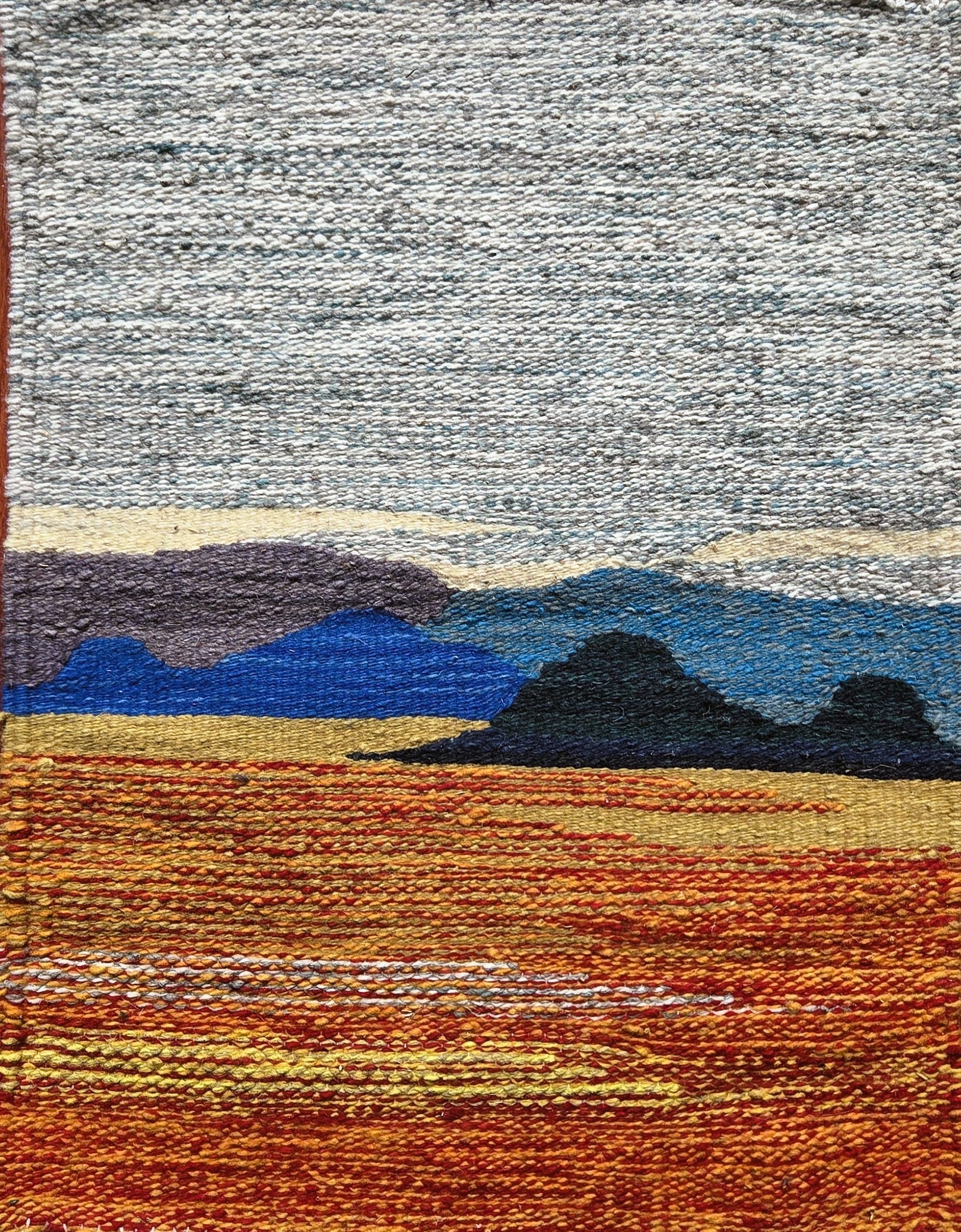
it just so happened to be Vivi’s design. The landscape depicts the misty blue mountains that flank Vivi’s workshop and the orangey reds of the fiery earth. The gray-blue of the sky and the river running through. It held all the colors of this land that had pressed their imprints against my eyelids so that I continue to see them even now when I drift off to sleep. Simultaneously, the depiction of this landscape reminded me of the valleys in the Pacific Northwest that slowly curve up into the Cascade ranges. The same misty mountains of the Olympics and the Cascades and the dried grasses at the end of summer before autumn rolls in the valleys had been captured in Vivi's weaving.
Two places, in different hemispheres with different climates and histories, reminiscent of the same image. In these moments, the ideas of borderlands, of distinct places and of national identities begin to fray and disintegrate. There is too much that holds us together if even our landscapes and traditions can parallel one another across space and time.
The words that capture what I feel came to me not in English, but in improper Spanish: La tierra en todos lados es roja como la sangre que corre en las venas.
The earth everywhere is red, just like the blood that flows through our veins.
We are simply different motifs within the same woven tapestry, beautifully in contrast, together.
Note: This piece was inspired by a visit to Casa Ollin rugs was organized by Intrepid Travel on their Medico Unplugged tour. This is not a sponsorship and I have written it of my own accord, but want to give credit to the company and our local tour guide Suz who made the visit possible.
This is Issue 7 of Micromoments. If you made it this far, I hope you had some tea with you and found some kernel of a thought, or reflection to consider.
*NEW*: If something did come up for you, a thread, a memory or experience, I have opened up the comment section for subscribed members. Please consider sharing your thoughts and ensure they are respectful, constructive, and invite intellectual/creative dialogue.
This newsletter is one big experiment. I welcome your thoughts, suggestions, reflections and questions/concerns any time. Please feel free to reply to this newsletter. I'll be listening on the other side! - Kamna